What Van Gogh Painting Was in the Degenerate Art Exhibition
Hitler'southward takeover of Germany and its surrounding nations was non but a military or genocidal feat. He wanted to completely overhaul the cultural fabric of Germania. That also applied to paintings. There was a certain style of German language art that he believed was superior, such as the piece of work of the "Old Masters" or realistic paintings of wholesome events.
In particular, Hitler wanted to eradicate modern art. According to the Reich, modern art was depraved and irrational. Dadaism, Impressionism, Cubism, Expressionism, and Surrealism were all verboten, and these paintings were all hauled out of museums. Hitler even declared, "The Dadaists, Cubists, and those futuristic expressive ones and those objective chatterers will under no circumstances participate in our cultural renaissance."
In July 1937, over 650 works were exhibited in the Institute of Archaeology in the Hofgarten in Munich. The pieces were displayed nether the championship of Entartete Kunst ("Degenerate Fine art"). Painted on the wall were captions, including ones that read, "Insolent mockery of the Divine under Centrist rule," "An insult to German language womanhood," and "Revelation of the Jewish racial soul."
On March 20, 1939, around v,000 paintings, drawing, and sculptures were thrown into a bonfire under the supervision of the Berlin Fire Department. More than were destroyed in Paris in July 1942.
Thankfully, many museum curators and ordinary citizens saw the Reich'due south savagery for what it was. Many works were smuggled out of occupied countries or hidden in desolate farmhouses or caves. Here are the stories of x works of art condemned past the Nazis and the people who created them.
Photo credit: CBS Sunday Morning via YouTube
x Moon Over A Mountain Lake
Max Beckmann
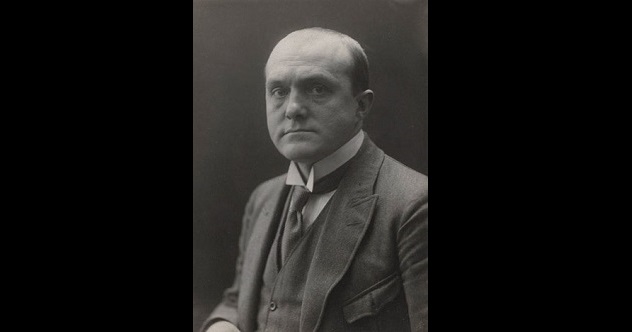
Max Beckmann (pictured above) focused on exaggerated, distorted, figurative drawings, which places him amongst the Expressionist artists. Later on his traumatic experiences serving in World State of war I, he sought to explore spiritual and political themes in his art. Beckmann'southward work was well received in postwar Deutschland, and he fifty-fifty received awards for his paintings.
Still, after Hitler's rise to power, Beckmann was dismissed from his instruction position at the Stadel Art School in Frankfurt. More than 500 of his works were removed from museums that aforementioned year. Beckmann fled to Amsterdam, where he waited out the war before immigrating to the The states.
Some of Beckmann'south pieces were featured in the 1937 Degenerate Fine art exhibit. In 2012, several of his important pieces were discovered in an apartment owned by an art collector who'd gotten his hands on hundreds of works looted by the Nazis. The watercolor Moon Over a Mountain Lake does not announced to accept been one of those paintings, but it was seized from the National Gallery in Berlin during the war, and it's now exhibited at the Bavarian State Painting Collections in Munich.
9 Bathers With A Turtle
Henri Matisse
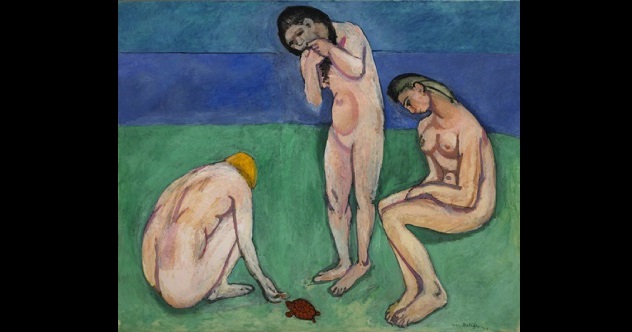
Photo credit: Henri Matisse via Wikimedia
Henri Matisse pioneered the style of Fauvism, a style of wide, visible brushstrokes and stiff, unrealistic colors that clashed with Hitler'due south vision of proper artwork. As such, Matisse's works were at serious take a chance.
The Nazis were a practical regime. They didn't just destroy artwork they disliked. They would often sell it cheaply to raise strange currency for the Reich. In 1939, Joseph Pulitzer Jr. was on his honeymoon when he came beyond one of these auctions taking place in Lucerne, Switzerland. Later on consulting with Pierre Matisse, son of Henri, he managed to rescue the painting for just $2,400. Pulitzer described the artwork for auction every bit "the most creative works of then-existing artists of that catamenia."
Matisse was permitted to continue exhibiting his works in Paris, bold he signed an adjuration declaring his "Aryan" status. He did so, writing to his son that he felt he would exist "deserting" his homeland if he fled.
8 The Absinthe Drinker
Pablo Picasso
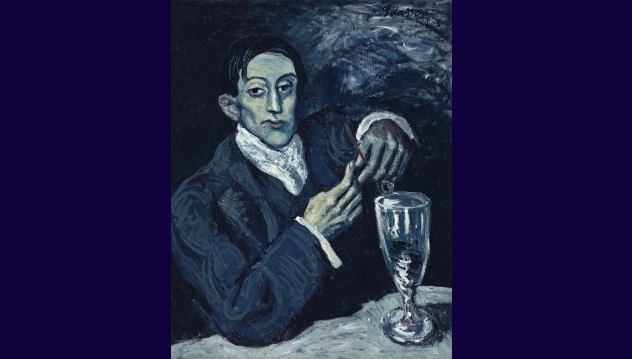
Photo credit: Pablo Picasso via Wikimedia
The Abstraction and Cubism of Pablo Picasso's paintings clearly made him a target for Nazi ridicule. While Picasso remained in Paris during the German occupation, he did non showroom his piece of work during this time. His famous Guernica showed his hatred of both warfare and the Third Reich, and the Nazis were surely enlightened.
Notwithstanding, The Absinthe Drinker was produced before the rise of the Nazis, during Picasso's "Blue Period." Also known every bit Portrait of Angel Fernandez de Soto, information technology depicts the immature artist drinking a glass of absinthe in front of a night groundwork. The painting became controversial in 2006 when then-owner Andrew Lloyd Webber announced his intentions to auction the painting for charity. Descendants of the previous owner, Paul von Mendelssohn-Bartholdy, protested that the painting had originally been sold under duress from the Nazis.
Indeed, the Mendelssohns (descendants of famed composer Felix Mendelssohn) have been trying to repossess a number of paintings, including works by Picasso and van Gogh. When Mendelssohn-Bartholdy, a German language Jew with an Aryan wife, realized the Nazis would attempt to confiscate all Jewish property, he attempted to arrange his will so his wife would "pre-inherit" his incredible collection. His daughters would so receive the works after his married woman's passing. After his death, however, his widow sold a number of priceless paintings, though whether the auction was forced by the Nazis or not seems to be a subject of debate.
Eventually, the matter was settled out of courtroom, with Lloyd Webber retaining ownership. The painting was sold to an anonymous bidder in 2010.
7 Reclining Nude
Gustav Klimt
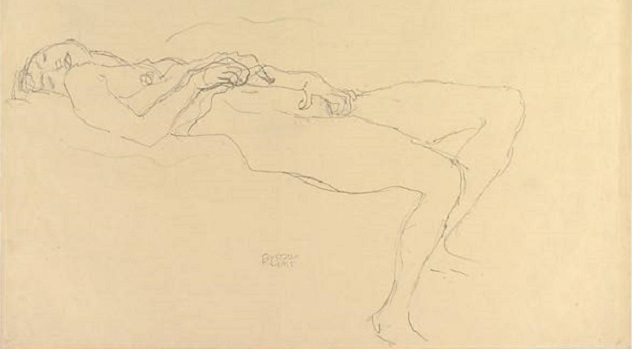
The abstract and erotic focus of Gustav Klimt'due south work fabricated him abomination to the Nazis, fifty-fifty though Klimt had died in 1918. Two of his drawings, both female nudes seized from the Kunsthalle Mannheim museum, are included in Freie Universitat Berlin'south database. Sadly, their current locations remain unknown, lost to the annals of fourth dimension.
The particular tragedy of Klimt's piece of work focuses effectually a woman named Adele Bloch-Bauer. Adele and her hubby, Ferdinand, were members of Vienna'due south high society. Adele posed for two of Klimt'southward portraits and perhaps more than paintings, including his most famous work, The Kiss. When Adele died at 43 years old, her married man created a memorial in their home using Klimt's artwork. Withal, when the state of war began, the Jewish Bloch-Bauer was forced to flee his dwelling and abandon all his belongings. He died in exile in 1945.
Nevertheless, his niece, Maria Altman, gained some justice for her late aunt and uncle. In 2006, an Austrian arbitration lath ordered that five paintings, including the ii portraits of Adele, be returned to Maria Altman's possession. The paintings are estimated to be worth $150 million. I now hangs in the Neue Galerie in New York and the other in the Museum of Modernistic Art.
6 Cocky-Portrait Dedicated To Paul Gaugin
Vincent Van Gogh
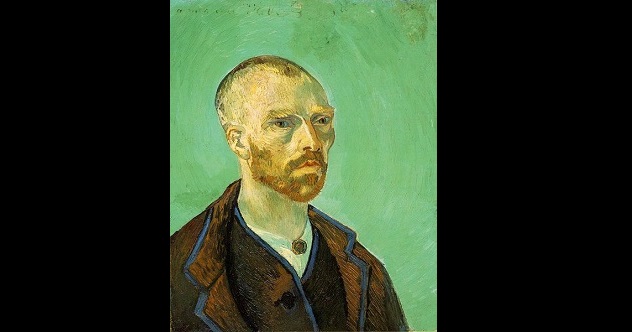
Photo credit: Vincent van Gogh via Wikimedia
Vincent van Gogh'south work found itself under Nazi scrutiny due to his Expressionist influences. The distorted swirls and cascading colors were too mod, thus making them too degenerate.
Van Gogh's cocky-portrait on a stunning seafoam background was donated to the Neue Staatsgalerie in Munich in 1919, just just 20 years afterwards, it was targeted by the Nazis. At some point between 1937 and 1938, the portrait was taken from the walls of the museum and auctioned for funds at Lucerne.
The van Gogh was then purchased for a hefty sum past Maurice Wertheim, who bequeathed the painting to the Harvard Art Museums. Much like Joseph Pulitzer Jr., Wertheim "seemed to believe that to support what the Nazis detested was justifiable." Unlike many other works on this listing, the painting was taken from a state-run museum, and therefore, information technology is not legally required to be returned.
Ironically, the fact that it was seized may be why the painting survived. As World War Two escalated, the Neue Staatsgalerie airtight. To protect its paintings, some were shipped outside Munich. Others were housed in the museum basement. Sadly, the structure was bombed, and many works were destroyed. But thankfully, this van Gogh was saved.
5 The War Cripples
Otto Dix
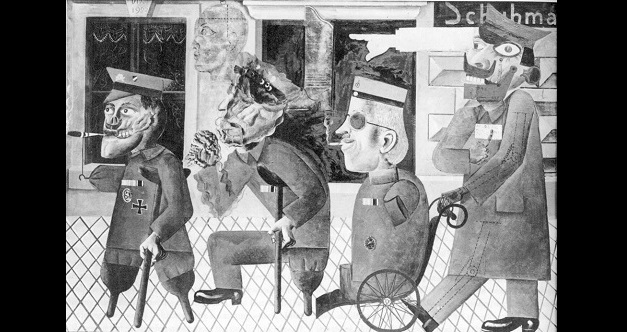
Of all the art styles that Hitler hated, he might've hated Dadaism the most. He railed against the style in Mein Kampf, claiming that Dadaism was "the degenerate excess of insane and depraved humans." Furthermore, he stated that Dadaists were "holding the expressions of national sentiment upwards to scorn, overturning the concepts of the sublime and the beautiful, the worthy and the good, finally dragging the people to the level of [their] own low mentality."
The Dadaists would likely have been flattered by this depiction. Early Dadaism began as sort of an "anti-fine art" movement, a satirical attack on capitalism and the suburbia that many Dadaists believed had fatigued their nations into World War I. Co-ordinate to artist Hans Richter:
"For everything that art stood for, Dada was to correspond the reverse. Where art was concerned with traditional aesthetics, Dada ignored aesthetics. If fine art was to appeal to sensibilities, Dada was intended to offend."
It'southward no wonder, then, that Otto Dix's hard-hitting The War Cripples remains lost. Though information technology is a painting, the way almost seems like a collage made from magazines. The painting ridicules everyone, including the military for crippling poor men, the public for their strange fascination with the handicapped, and the injured men themselves for retaining pride in a state that sent them to war. The painting was featured in the Degenerate Fine art exhibit, and so information technology was probably destroyed.
four Color Social club
Hans Richter
Hans Richter was another Dadaist who unabashedly opposed the Nazis. Richter, who'd served in World State of war I and had go partially paralyzed, firmly believed information technology was the duty of artists to oppose war and support revolution. He slammed militaristic Germany in his pen-and-ink drawings and studied color and composition in his abstract paintings. Richter was besides a pioneer in abstruse film, with his Rhythmus 21 beingness extremely of import in the motility.
Evidently, neither his heavy satire nor excessive use of abstract lines and color could remain in the Reich's cultural vision.
Farbenordnung, which translates into Color Order, appears to be ane of Richter's abstract colour studies. Once housed in the Provincial Museum in Hannover, it was seized and exhibited in Entartete Kunst before information technology was finally destroyed. Equally for Richter himself, he immigrated to the US in 1941.
3 Winter Garden
Paul Klee, 1925
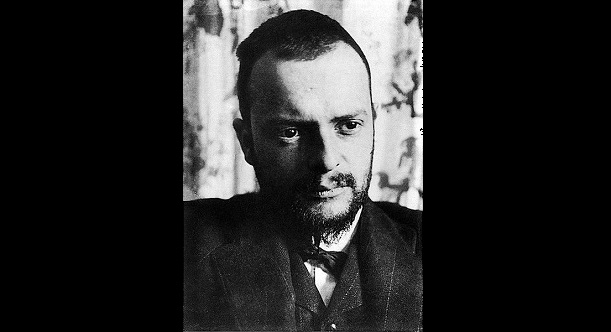
Paul Klee has the unsavory distinction of being a rare Jewish artist in the time of the Nazis. In addition to this "terrible crime," Klee was a modern artist. Though difficult to allocate, his painting spanned the realms of Expressionism, Cubism, Surrealism, and Abstraction.
From 1931 to 1933, Klee taught at the Dusseldorf University. However, his career was cut short by an investigative Nazi newspaper. "He tells everyone he's a thoroughbred Arab," reported the rag," but he'south a typical Galician Jew." The Gestapo searched his home, and Klee was fired.
To bargain with this consequence, Klee created Struck from the List, a painting in which a monochromatic, abstract person is seen crying as a blackness "X" covers his (or her) confront. Klee and his family fled to Switzerland shortly thereafter. As for his piece of work entitled Winter Garden, it was seized from the Civic Museum of Arts and Crafts in Halle, along with hundreds of his other works. Tragically, 17 of his paintings were exhibited in Entartete Kunst, and this particular piece was destroyed.
ii La Belle Jardiniere
Max Ernst
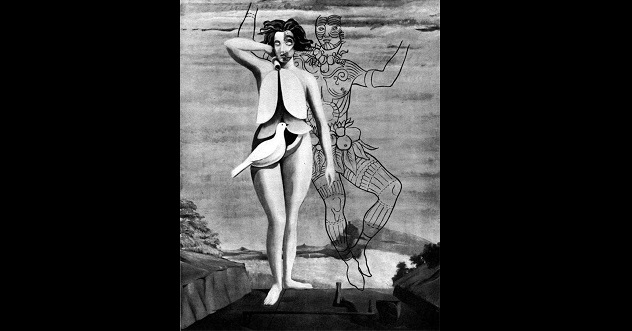
Max Ernst was yet another Dadaist, and when World War Ii broke out, Ernst establish himself trapped in Paris as an "undesirable foreigner," even though he was a native High german. After the intercession of some famous friends, Ernst was released, simply to be after arrested past the Gestapo when the Germans invaded Paris. He and then managed to escape to America with the help of Peggy Guggenheim, a wealthy patron of the arts.
Ernst was unafraid of tackling touchy subjects in his artwork. In one famous painting, Ernst depicts the Virgin Mary spanking a immature Christ while three famous painters, including Ernst, watch from a window. In La Belle Jardiniere (Creation of Eve), Ernst paints a nude Eve, consummate with a scandalously placed dove. Backside Eve, there'south a line drawing of a woman made of fruit.
At least two of Ernst's works were displayed in Entartete Kunst. Interestingly, a photo taken at the exhibit shows Hitler walking by La Belle Jardiniere. Sadly, records of this painting were lost after the issue, and it may have been destroyed past the Nazis.
one Self-Portrait Every bit A Soldier
Ernst Ludwig Kirchner, 1915
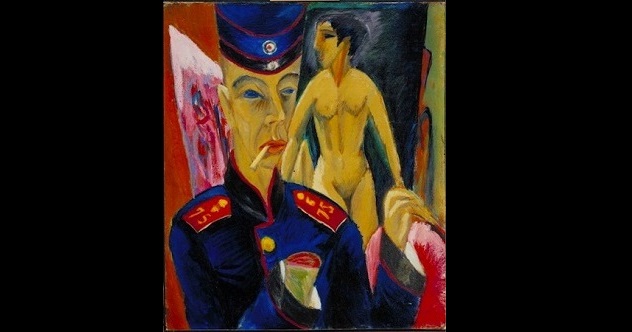
Photo credit: Ernst Ludwig Kirchner via Khan Academy
Ernst Ludwig Kirchner led a troubled yet influential life. He was plagued by physical and mental illnesses, both fabricated worse past his fourth dimension every bit a Globe War I soldier. However, he was as well the founding member of "The Bridge," a grouping that hoped to course, well, a bridge betwixt old and new styles of art. Thanks to Kirchner, these artists were highly influential in the catamenia leading to the appearance of Expressionism.
Self-Portrait as a Soldier is probably 1 of the most important pieces Kirchner e'er created. In the foreground, we meet Kirchner in military uniform, holding upwardly a stump where his right hand one time was. His face is highly stylized. In the background, nosotros see the artist'south studio, complete with a nude model. The colors are brilliant, all the same they're sad as well. Information technology brings together the complexities that Kirchner was dealing with during this time in his life.
In 1933, the Nazis rose to power, damning Kirchner's abstract fashion and making information technology impossible for him to sell his paintings. He was forced to resign from the Prussian University of the Arts. In 1937, over 600 of his works were removed from museums in Germany, and at least 32 were displayed at the Degenerate Arts exhibit. Tragically, Kirchner took his own life in 1938.
Hannah is a freelance writer and skydiver. A proud Jersey girl with a background in political science, criminal justice, and motorcar sales, she can be reached here for commissions and other data. You can read more of her piece of work at morbidstreak.blogspot.com.

Postar um comentário for "What Van Gogh Painting Was in the Degenerate Art Exhibition"